


Dissertation Writing Contest guidelines
General Guidelines

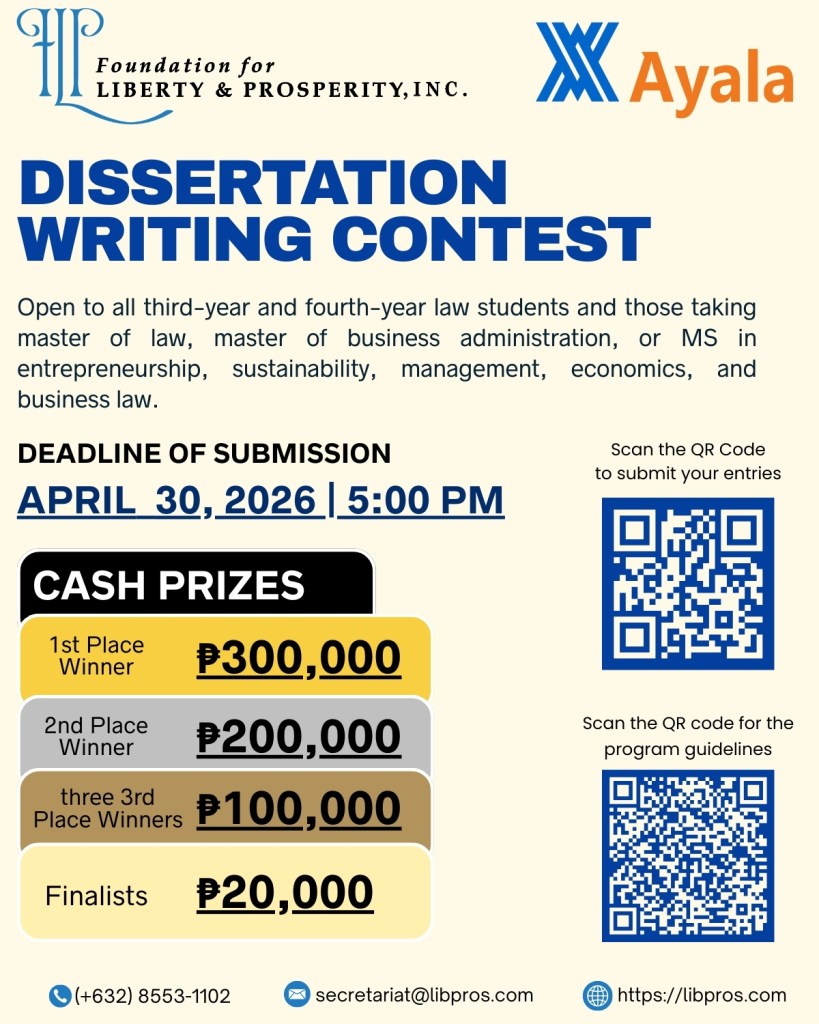
1. Eligibility. The Foundation for Liberty and Prosperity (FLP) is sponsoring a dissertation writing contest in partnership with the Ayala Group and in cooperation with the Philippine Association of Law Schools. The contest is open to third-year and fourth-year law students and those taking Master of Law, MBA or MS in entrepreneurship, sustainability, management, economics, and business law. Only one (1) entry per student is allowed. Each entry must be a thesis/dissertation/research paper that espouses the philosophy of liberty and prosperity under the rule of law. An entry must have gone through the process of a thesis/dissertation or a procedure similar thereto and that it is of thesis/dissertation/research paper type and quality. The schools shall do the initial vetting of entries and endorse to FLP the top five entries from their respective schools.
Research that has already been published in journals and newspapers will no longer be eligible for the contest.
FLP officers, staff, and their relatives up to the third degree of consanguinity or affinity are not eligible to join.
2. Subject Matter. Entries must be written in English and must address current issues facing the legal system, especially the theme of promoting Liberty and Prosperity. It should concern the philosophy of the Foundation, expanding on and espousing the precept: protection of liberty and nurturing of prosperity under the rule of law, as it relates to practical applications on various aspects of legal theory and practice. Multi-disciplinary perspectives in the paper are encouraged.
Schools may develop a Liberty and Prosperity focus within the legal area where they have subject matter domain and expertise, e.g., human rights, and indigenous peoples’ rights.
3. Authorship. An entry must be certified by the author/s on the Entry Certificate to be their original and sole work. In case an entry has been submitted to and accepted by the author/s’ school for purposes of dissertation/thesis requirements, the author/s must be free to execute the assignment of copyright included in the official Entry Certificate and must likewise certify that they have permission to submit the same or similar work to the FLP Dissertation Contest.
Some law schools allow students to submit a collective dissertation to fulfill JD requirements. FLP will accept collaborative dissertations/research papers as entries to the contest.
4. Qualifying Entries and the Short List. Initially, up to twenty (20) finalists will be chosen by the FLP Dissertation Writing Contest Committee from all entries submitted.
5. Judging and Winning Entries. The FLP Board of Judges will choose up to five (5) recipients of the primary awards (first, second and third place) from the finalists. The winning entries shall be affirmed by FLP whose decision shall be final.
6. Judging Standards. Entries will be judged on the following factors:
- The choice of subject matter, as measured by its significance, relevance, and timeliness;
- The amount of work and effort, as measured by the entry’s comprehensiveness and analysis;
- The quality of the legal analysis, as measured by its innovativeness, objectivity, depth, exposition, and coherence; and
- The writing quality, as measured by the clarity of expression, brevity, and literary construction.
7. Monetary Awards and Plaques. Monetary awards are as follows: ₱300,000 to the first-place winner, ₱200,000 to the second-place winner, and ₱100,000 each to three (3) third-place winners. These winners will also receive plaques of recognition. The twenty (20) finalists chosen by the FLP Dissertation Contest Committee will each receive ₱20,000 and a certificate of award. Prizes will not be awarded if FLP determines that no entry meets the appropriate standards.
Faculty mentors of winning contestants shall receive monetary awards as follows: ₱100,000 for the faculty mentor of the first-place winner, ₱75,000 for the second-place winner, and ₱50,000 each for the 3 third-place winners.
The awards for the dissertation contest are provided by generous donors. The Foundation, its officers, and staff are not liable if the donors fail to provide the monetary award.
8. Copyright and Publication. FLP shall own the copyright of all winning entries. Winning entries will be made available for publication in current and future publications of the Foundation. In case the winning entry is also submitted as part of the student’s academic requirements, FLP is amenable to co-ownership of the copyright for said entry with the concerned law school. Entrants are expected to notify FLP at the time of the submission of the Entry Certificate of any prior acceptance by another publication or submission as an academic requirement. FLP shall allow publication of the winning entries in the respective law school journals of the authors provided that proper attribution is made.
9. Deadline for Submission of Entries. Entries must be submitted to FLP on or before 5 p.m. on April 30, 2026 (Thursday). Five (5) hard copies of the entries together with one copy of the duly completed Entry Certificate and the endorsement by the school must be mailed or hand-delivered to: Foundation for Liberty and Prosperity, 3rd Floor, PCCI Corporate Centre, 118 L.P. Leviste Street, Salcedo Village, 1227 Makati City.
In addition, entries must be transmitted electronically in MS Word and PDF via the contest’s official via Google Forms. FLP reserves the right to reject any entry at its discretion.
10. Revisions. FLP reserves the right to update and revise the guidelines for the dissertation contest which shall be announced on its website: www.libpros.com
Writing Guidelines
1. Substance
- Legal Analysis. The author’s thesis, as well as the arguments to support it, must be clearly and logically presented. Entries must justify their conclusions with sound reasoning and pertinent authorities.
- Choice of Subject. Item 2 of the General Guidelines allows for a broad range of topics, provided it is one that adds to the growing body of work on the philosophy of FLP and locates it in the legal landscape of Philippine law and jurisprudence thus giving its tenets practical application. Topics may cover social justice, socio-economic rights, economic development, and poverty alleviation and may take up specific subjects like empowerment of the poor and marginalized, promotion of entrepreneurship, free trade and investments as well as professional integration. Innovative subjects are encouraged within the bounds of reason and logic and guided by what has so far been written and laid down about the philosophy. Entrants are encouraged to refer to the writings and speeches of Retired Chief Justice Artemio V. Panganiban on the philosophy of FLP, particularly his work titled Unleashing Entrepreneurial Ingenuity, and the lecture of Professorial Chair Holder and UP College of Law Professor Elizabeth Aguiling-Pangalangan.
- Quality. Entries should be of thesis or dissertation type and quality.
- Attribution. The entries must not parallel their sources too closely in form or content, and direct quotations must always be shown as such. Quoting from the writings of others is permissible, provided due attribution is given. FLP takes a strong position against plagiarism and will take the necessary action against it.
2. Form:
- Format. Entries must be written in single-space with a 1 ½ space between paragraphs, using Book Antiqua, Times New Roman, or Garamond font style, of 14-size font, and on an 8.5-inch by 11-inch white bond paper with the following margins: left-hand margin of 1.5 inches from the edge; an upper margin of 1.2 inches from the edge; a right-hand margin of 1.0 inch from the edge; and a lower margin of 1.0 inch from the edge. (See A.M. No. 11-9-4-SC on Efficient Use of Paper Rule issued by the Supreme Court on November 13, 2012.) Entries must be stapled or secured by a ¾-inch width binder clip/double clip, not placed in a binder or hole-punched.
- Organization. Entries must be organized and presented in a logical and orderly manner. Only footnotes are acceptable, and entries must follow the Philippine Manual of Legal Citations by Professor Myrna S. Feliciano and/or Legal Research and Legal Citation by Milagros Santos-Ong (both based on The Bluebook: A Uniform System of Citation by the Harvard Law Review). Legal scholarship is characterized by extensive documentation and entries must support their propositions with authority duly reflected in the footnotes. Footnotes should be in 10-point font size and must follow the font type used in the body of the entry.
- Abstract. Entries must have a table of contents and headings for quick reference as well as a detailed outline to facilitate review. Entries should also have an abstract of not more than 500 words.
- Writing Style.
- Simple. A simple writing style is encouraged. Avoid long sentences and lengthy paragraphs whenever possible. Simplicity in form should not limit depth in substance.
- Clear. The entries must be clear and coherent, pursuing specific lines of reasoning towards a well-developed conclusion.
- Brief. Brevity is encouraged, but it should not compromise substance. A well-written entry should include all points necessary for the full treatment of the proposition being presented or the subject matter chosen. Minimum number of words: 10,000; maximum number of words: 15,000, including footnotes.
For further information, contact us:
- Visit libpros.com
- Email to secretariat@libpros.com
- Call (632) 8553-1102
- Visit us at the FLP Headquarters:
3rdFloor, PCCI Corporate Centre, 118 L.P. Leviste Street
Salcedo Village, 1227 Makati City
In cooperation with: