
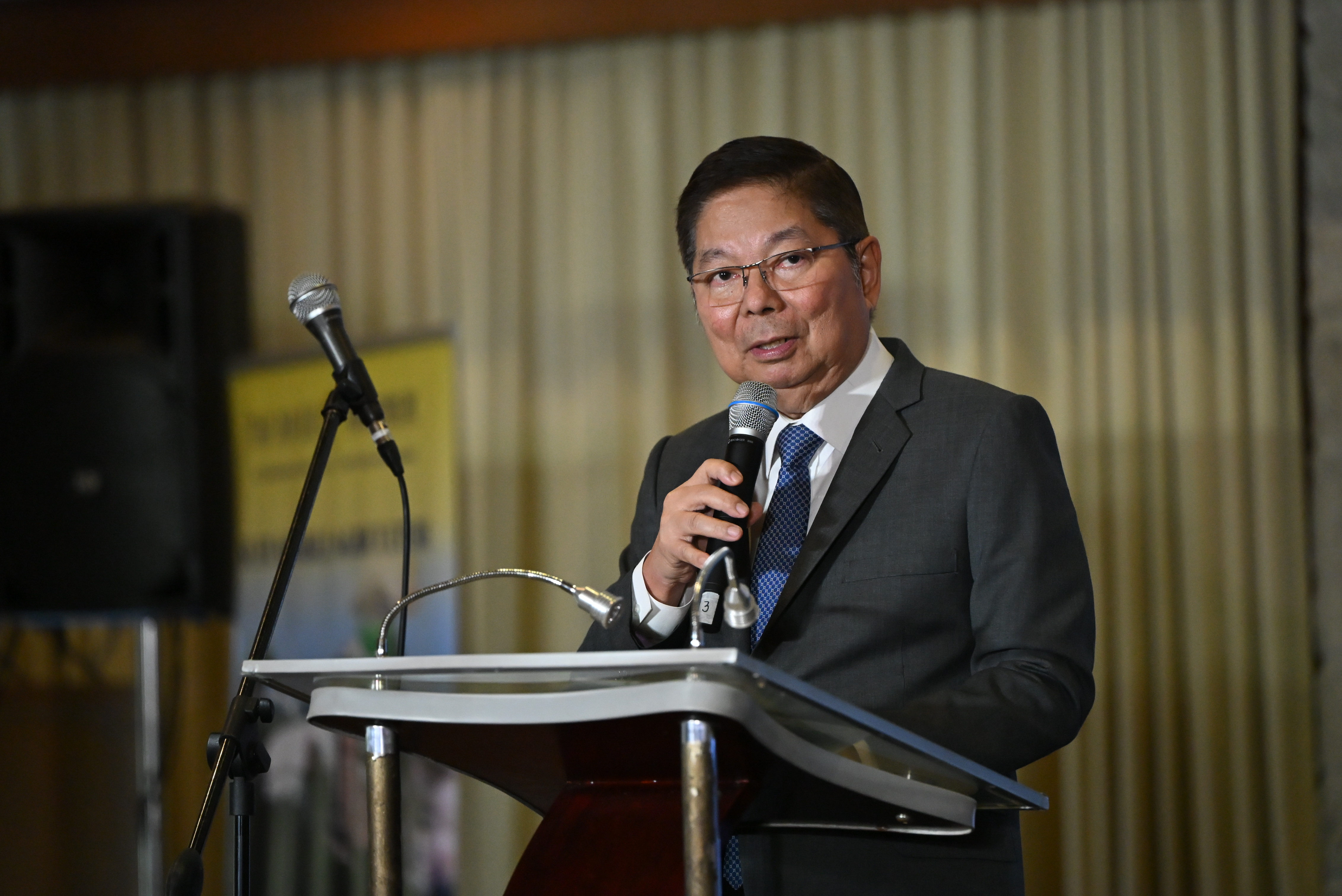
Introduction of Governor Eli M. Remolona, Jr. by Amando M. Tetangco, Jr. at the FLP Awards Ceremony on September 16, 2026 at the Main Lounge, Manila Polo Club, Makati City.
Distinguished guests, esteemed trustees and members of the Foundation for Liberty and Prosperity, our scholar and fellows, dissertation awardees, parents, partners, ladies and gentlemen, good evening.
The economist Daron Acemoglu, who shared the 2024 Nobel Prize in Economics for his work on institutions and prosperity, once said that “Institutions are always about choices.” What rules of the game do we establish? What opportunities do we create? And, perhaps most importantly, in whom do we invest?
That thought seems particularly appropriate tonight.
The Foundation for Liberty and Prosperity invests in scholars, fellows, and researchers because good institutions ultimately depend on good people. People with ideas, integrity, and the courage to make difficult choices. People who embody the Foundation’s guiding principle that liberty and prosperity must be safeguarded and nurtured together under the rule of law.
I can’t think of many who reflect those qualities better than the person I have the privelege of introducing tonight, Governor Eli M. Remolona Jr.
Eli and I both studies economics in Ateneo, although at different times and he took the more challenging Economics Honors Program. He later earned his doctorate in economics, with Distinction, from Stanford University.
I remember first meeting Eli early in the 1980s, when the Philippines was in the difficult process of renegotiating its external debt. I was working from the Philippine central banking side, while Eli was with the Federal Reserve Bank of New York.
Eli would go on to build an outstanding international career. He spent 14 years at the Federal Reserve Bank of New York and another 19 years at the Bank for International Settlements.
For many years, we would find ourselves looking at the same Philippine economy from different vantage points. I was looking at it from Manila and the BSP. Eli was looking at it from New York, Basel, and later Hong Kong. But we were always working toward the same goal: a stronger and more resilient Philippine Economy.
That is one thing worth emphasizing about Eli tonight. Although he built a truly international career, he never lost sight of the Philippines. In fact, from 1990 to 1991, he returned as part of a high-level economic missions with Paul Krugman, who would later receive the Nobel Prize in economics, and Susan Collins, who is now President of the Federal Reserve Bank of Boston. Together, they advised the Philippine government on structural reforms, arguing that a more open and competitive economy was essential for raising productivity and sustaining growth.
Throughout his career, Eli maintained a deep connection to the Philippines and the broader region. At the BIS he served as the Head of the Representative Officer for Asia and the Pacific based in Hong Kong. In that role, he worked closely with central bank governors across the region on monetary policy, financial stability, regulatory reform, and capital market development.
Yet Eli has never been simply a practitioner. His career also speaks of a duty to share knowledge, mentor others, and help prepare the next generation of leaders. He has taught at Williams College, Columbia University, New York University, the Asia School of Business, which was established as a collaboration between MIT and Bank Negara Malaysia, and the University of the Philippines. He has helped shape minds that will, in turn, shape communities and institutions.
That combination is rare. Eli moves comfortably between ideas and policy, between the classroom and the board room, and between academic research and the practical challenges of policy making.
Eventually that journey brought him home. He first served on the Monetary Board, and then, in 2023, became the seventh Governor of the Bangko Sentral ng Pilipinas.
I believe his journey matters because today’s operating environment is becoming increasingly challenging and complex. Geopolitical fragmentation, rapid and sometimes disruptive technological change, and growing uncertainty force us to make difficult choices with significant trade-offs.
Eli captured this reality succinctly in a speech marking the Supreme Court’s 125th anniversary when he said, “It’s easy to do the popular thing. It is harder to do the right thing.”
Having sat in that chair myself, I know exactly what he means.
Central bankers are often called upon to make difficult decisions. The right decision is not always the easiest one. Its benefits may not be immediately visible, but it is the Governor’s responsibility to make that call.
That requires expertise. But it also requires judgement and courage. These are qualities I have seen in Eli over the many years I have known him.
And perhaps that brings us back to Acemoglu’s observation. Institutions are indeed about choices. But behind every institution are men and women entrusted to make those choices wisely, especially when the right choice is not the east or popular one.
I am very pleased that the Bangko Sentral ng Pilipinas is in capable hands.
Ladies and gentlement, it is my privilege to introduce an old friend, a fellow Atenean, a distinguished economist, scholar, and public servant, and the Governor of the Bangko Sentral ng Pilipinas, Governor Eli M. Remolona, Jr.
