
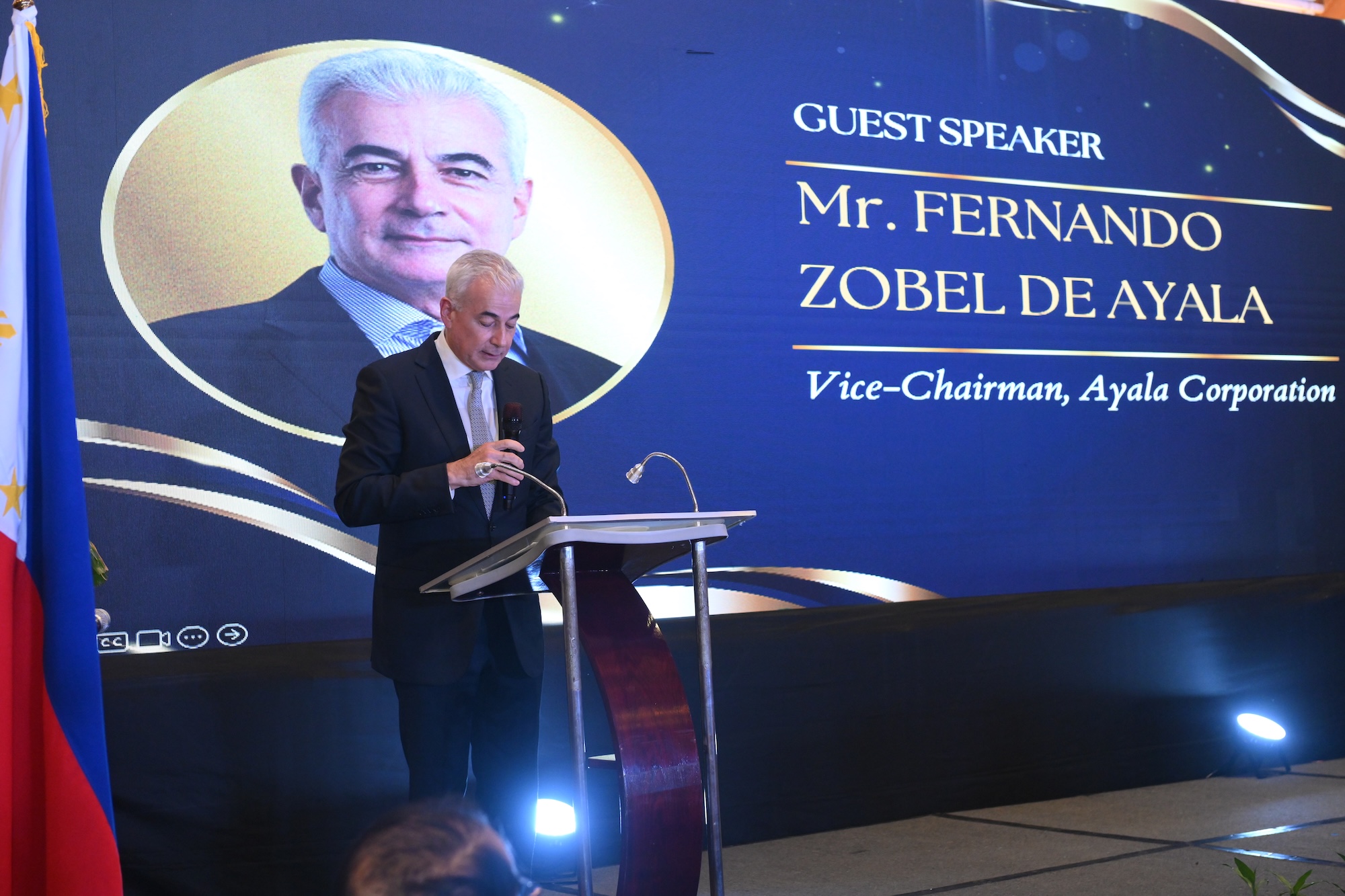
Keynote speech of Mr. Fernando Zobel de Ayala during the awards ceremony of the Foundation for Liberty and Prosperity held on August 29, 2025, at the Manila Polo Club.
First Lady Liza Araneta Marcos,
Chief Justice Art Panganiban,
Chief Justice Alexander Gesmundo,
Leaders from government,
Members of the Board of Trustees and friends and partners of the Foundation for Liberty and Prosperity,
Colleagues in industry and the legal profession,
Good evening and thank you for this opportunity to speak to you this evening.
I am honored to celebrate with you the best and brightest minds in Philippine law and to have the chance to show our shared commitment to support the advancement of our legal system.
Before anything else, allow me to thank Chief Justice Art Panganiban. CJ Panganiban continues to be a valued friend and partner of the Ayala Group, and as we all know remains among the country’s eminent legal luminaries. We at Ayala are fortunate to have had him as a long-time director at the Bank of the Philippine Islands. His principle on ensuring that businesses create benefits for all, within a legal framework of fairness, continues to be a key operating principle across all our companies.
Ayala remains a proud supporter of the Foundation for Liberty and Prosperity. Our continued support for your dissertation writing contest is an affirmation of our belief in the importance of legal scholarship. We support meaningfully critiquing and ultimately closing the gaps that exist in our laws, and in developing up-and-coming lawyers, who will one day shape the country’s legal landscape.
We share everyone’s belief that liberty and prosperity are twin principles that go hand-in-hand – one cannot exist without the other. People can only realize their full potential when they are free to make informed choices that improve their lives without hindrances.
This means that our people should live with dignity in a safe environment, with food on the table, a roof over their heads, gainful employment, and the ability to freely express themselves.
This also means fostering an economic system that promotes fair competition, rewards initiative and innovation, and ensures that value is created and shared in ways that benefit more people.
Along these lines, the Foundation for Liberty and Prosperity continues to make tremendous contributions to institutionalize CJ Panganiban’s philosophy of liberty and prosperity under the rule of law. The FLP’s work remains vital to bolstering how we understand and apply our laws, while also providing opportunities for excellent students to pursue studies in this and adjacent disciplines. I find it noteworthy that scholarships are provided not just for those seeking to take legal studies, but also entrepreneurship, economics, and even sustainability.
It is crucial that we continuously develop our legal talent and the profession. The country’s legal system is not perfect, but institutions, such as FLP and the work that it does, are vital in pushing our country and laws towards greater relevance to the people, and effectiveness in dispensing justice.
I believe this is where the FLP’s work in advancing legal scholarship becomes especially valuable. We should continue to support and grow this field.
Even as we aim to create laws that are broad and ready for the future, there will always be situations we can’t predict. Unintended consequences are often hard to understand and manage. That’s why we need fresh perspectives and more creative ways of studying our laws—to make sure they truly uphold liberty and prosperity for everyone. The FLP is a powerful source of these forward-thinking minds.
Over the years, we have seen the FLP’s dissertation contest winners look at various facets of our legal system, seeking ways to enhance the fair application of the law and its spirit. Winners and finalists have analyzed statutes related to climate change, cybersecurity, the risks and opportunities presented by artificial intelligence and digital technologies, intellectual property rights and protection, health and well-being, even international law and justice. These are all excellent starting points.
True liberty and prosperity would only be possible if Philippine law and the legal system adapts to the demands of the times. Most importantly, they should both place people at the center – after all, the main beneficiaries of the law are the people that it seeks to protect.
Several dissertations, commentaries from CJ Panganiban himself, as well as from the friends of the FLP, have touched upon the rapid development of AI and digital technologies. I think that these should be areas of interest that our legal scholars should investigate further. The fast march of technology has massive implications on our legal and policy environment.
Our systems were intentionally built with caution and complexity—not to hinder progress, but to safeguard fairness, uphold justice, and minimize the risk of far-reaching errors. This deliberate pace often seems at odds with technology, which, by its very nature, advances at an astonishing rate.
Our system will continue to face challenges in adapting swiftly and staying relevant. New developments emerge almost daily, delivering undeniable economic efficiencies. Yet we must remember: technology should not stop at automation—it should strive for enhancement. It should augment human capability, not simply substitute it with low-cost or free labor. A people-centric approach offers a more purposeful lens through which to view technology and its interaction with the law.
Automation threatens to displace both clerical and knowledge workers, where Filipinos enjoy a distinct competitive advantage.
Generative AI likewise threatens the creative industries, not just because of the potential loss of jobs, but also because of questions on intellectual property rights.
The law, as well as all of us in our own fields of expertise, should do our part to help transition people towards continued relevance.
Secondly, we have also seen the increasing attention on sustainability as a burning global issue. The amount of scrutiny and analysis that sustainability has received has risen globally. Regardless of differing opinions, I think we can all agree that sustainability offers a vital pathway toward a future where liberty and prosperity can truly flourish. When the law—and each of us in our respective fields—engages with this challenge, we help build a world that is not only equitable and resilient, but also rich in opportunity for all.
The Philippines holds the distinction of having the writ of kalikasan to protect the people’s constitutional right to a healthy and safe environment. As we strive to ensure environmental stewardship and conservation, we must also guarantee that our resources are used appropriately. Filipinos today and tomorrow should fully enjoy the benefits that our naturally rich country can provide.
Sustainability, however, goes beyond just the environment. It is a much more holistic area that involves inclusion, equity and social justice, as well as good governance and ethics. It is usually in these areas where the fiercest legal battles arise. The law – from the time they are written, to their interpretation and application – should advance equity and inclusion. All people, regardless of their background, should have a fair chance to realize their full potential.
To close, we live in highly complex times. Tonight, we recognize the best and brightest pieces of legal research and are sending off a fresh batch of scholars to build their expertise in their respective fields. To all our awardees, it is our collective hope that you will continue to place people at the heart of everything that you do. The law is a formidable force that can build institutions, safeguard rights, and hold people accountable. Together, let us champion liberty and shared prosperity for every Filipino through the law.
Thank you very much, good evening, and congratulations for all that we are celebrating today.
